Last updated: October 2026
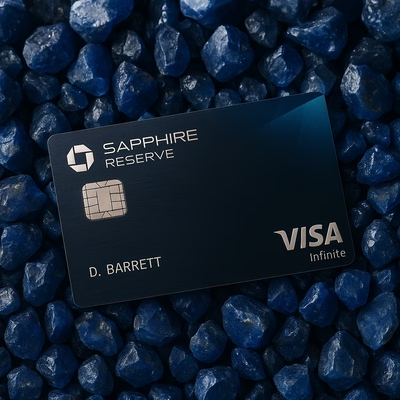
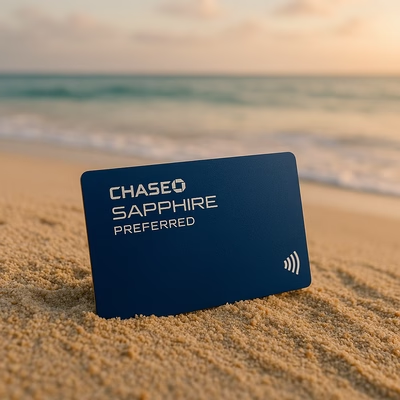
In a world where premium credit cards seem to be locked in an arms race of ever-increasing annual fees—looking at you, Chase Sapphire Reserve with its $795 price tag—the Chase Sapphire Preferred stands out like a beacon of sanity. At just $95 annually, it delivers 80% of what makes premium cards great without the wallet-draining fees that make you question your life choices every renewal cycle.
But here’s what makes the Sapphire Preferred truly special: it’s not just a great standalone card (though it absolutely is). It’s the keystone of the legendary Chase trifecta strategy—a three-card setup that can generate more value per dollar in annual fees than any other credit card combination on the market. Think of it as the Swiss Army knife of travel rewards: simple, reliable, and surprisingly versatile. For a comprehensive comparison of how it stacks up against other mid-tier premium cards, check out our detailed Chase Sapphire Preferred vs Amex Green vs Citi Strata Premier comparison.
Chase refreshed the card in June 2026, adding 3X on gas and EV charging, doubling the hotel credit to $100, and adding a Global Entry/TSA PreCheck credit, all while keeping the $95 fee. It also took a few things away (more on the Hyatt transfer ratio and the anniversary bonus below), but for most people the card is better than it was. Let’s dive into why this might be the only premium card you actually need.
Quick Start: Want to see how the Sapphire Preferred fits into your specific spending pattern? Try our credit card optimizer to get personalized recommendations based on your exact monthly expenses.
The Sapphire Preferred at a Glance: October 2026
The Numbers That Matter
- Annual Fee: $95 (refreshingly reasonable)
- Welcome Bonus: The public offer was 75,000 Ultimate Rewards points after spending $5,000 in the first 3 months as of October 2026 (offers vary; Chase ran a limited-time 100,000-point offer earlier in 2026)
- Bonus Value: Approximately $1,537 when transferred to partners (based on TPG’s 2.05¢ valuation)
- Break-Even Math: You’d need to spend about $4,000 annually to offset the fee through earning multipliers alone
Core Earning Structure
The Sapphire Preferred’s earning rates might look modest compared to some flashy competitors, but there’s genius in the simplicity:
- 5X points on travel purchased through Chase Travel (the amount covered by the $100 Chase Travel hotel credit doesn’t earn points)
- 3X points on dining, including eligible delivery services, takeout and dining out
- 3X points on gas stations and EV charging (new in June 2026)
- 3X points on vacation homes booked directly with Airbnb, Vrbo and similar sites (new in June 2026)
- 3X points on online grocery purchases (excluding Target, Walmart and wholesale clubs) and select streaming services
- 2X points on other travel purchases
- 5X points on Lyft rides through September 30, 2027
- 1X points on everything else
Here’s the kicker: those points are worth 1¢ each through Chase Travel as a floor, up to about 1.5¢ on select Points Boost bookings, and potentially much more when transferred to partners. (Cardholders who opened before June 23, 2025 can still redeem points earned before October 26, 2025 at the old 1.25¢ rate through October 2027.) That 3X on dining? At TPG’s 2.05¢ valuation it’s worth roughly 6% back.
If you’re choosing between travel credit cards, you might also want to compare this with the American Express Gold Card’s 4X dining rewards, especially if restaurant spending is your biggest category.
Welcome Bonus: 75,000 Points of Pure Potential
Let’s talk about that welcome bonus for a hot minute, because 75,000 Ultimate Rewards points is no joke. To put this in perspective:
Real-World Redemption Examples
Option 1: Chase Travel Portal (Minimum Value)
- 75,000 points × 1¢ = $750 in travel bookings, or up to about $1,125 on select Points Boost bookings at 1.5¢
- Perfect for: Domestic flights, hotel stays, rental cars with maximum flexibility
Option 2: Transfer to World of Hyatt (Premium Value)
- 75,000 points = 56,250 Hyatt points at the Sapphire Preferred’s 4:3 ratio, enough for one night at the top tier of Hyatt’s Category 8 hotels (like Park Hyatt Maldives) or one to two nights at the lowest tier
- Cash value: Often $1,500+ for luxury properties
- Perfect for: Once-in-a-lifetime luxury experiences
Pro Tip: Ready to maximize your welcome bonus strategy across multiple cards? Our credit card optimizer can help you plan out which cards to apply for and when, ensuring you hit minimum spend requirements efficiently while maximizing your total rewards potential.
Option 3: Transfer to United MileagePlus (International Value)
- 75,000 points = Round-trip economy to Europe or business class to Central America
- Cash value: $1,200-2,500 depending on routing and dates
- Perfect for: International adventures with excellent availability
The beauty of Ultimate Rewards is that you don’t have to decide immediately. Points don’t expire as long as you keep the account open, giving you time to find the perfect redemption opportunity.
Transfer Partners: Your Gateway to Premium Travel
This is where the Sapphire Preferred truly shines. With access to Chase’s 14 airline and hotel transfer partners, your points become incredibly versatile. Before you move them, check transfer bonuses.
Hotel Partners (The Heavy Hitters)
World of Hyatt (4:3 transfer ratio for Sapphire Preferred)
- Since the June 2026 refresh, Sapphire Preferred points transfer to Hyatt at 4:3 (1,000 Ultimate Rewards points become 750 Hyatt points). The change applied immediately to new cardmembers and took effect for existing cardmembers on October 1, 2026. The Sapphire Reserve still transfers 1:1.
- TPG values Hyatt points at 1.65¢ each, so a Hyatt transfer from the Preferred now works out to about 1.24¢ per Ultimate Rewards point at that valuation. Hyatt still shines for high-value nights, but it’s no longer an automatic win.
- Sweet spot: Category 1 properties from 3,000 Hyatt points per night (4,000 Ultimate Rewards points) under the award chart Hyatt introduced in May 2026
- Luxury play: Category 8 properties from 35,000 Hyatt points per night at the lowest pricing tier, up to 75,000 at the top tier
- Plan ahead: Hyatt now uses five pricing tiers per category, so check the exact date’s price before transferring
Marriott Bonvoy (1:1 transfer ratio)
- Best for: Wide selection of properties worldwide
- Sweet spot: Off-peak Category 5 properties at 35,000 points
- Luxury play: Ritz-Carlton properties using peak pricing strategically
IHG Rewards Club (1:1 transfer ratio)
- Best for: Value-conscious travelers
- Sweet spot: Holiday Inn Express properties at 15,000-25,000 points
- Luxury play: InterContinental properties during promotions
Airline Partners (The Adventure Enablers)
United MileagePlus (1:1 transfer ratio)
- Domestic value: Saver awards on short domestic routes often price at the low end of United’s dynamic pricing
- International value: Partner business class to Europe on Star Alliance carriers when saver space opens up
- Tip: United prices dynamically, so compare the miles price against the cash fare before transferring
Southwest Airlines (1:1 transfer ratio)
- Simple pricing: Award prices track cash fares, so sales make points go further
- Sweet spot: Wanna Get Away fares during sales
- Note: Points transferred from Chase don’t count toward A-List status or the Companion Pass
Air Canada Aeroplan (1:1 transfer ratio)
- Hidden gem: Aeroplan’s distance-based partner chart, which can make short-haul North American flights very cheap in points
- Bonus: Access to Star Alliance partners with no fuel surcharges on many carriers
The $100 Annual Hotel Credit: Free Money, Almost
Here’s a benefit that can nearly cover the annual fee by itself. Since the June 2026 refresh, the Sapphire Preferred includes up to $100 in statement credits each account anniversary year for hotel stays purchased through Chase Travel (up from $50). The credited amount doesn’t earn points.
How to Maximize This Credit
The credit applies to hotel bookings only (not flights or rental cars) through Chase Travel, and it’s surprisingly easy to use:
- Plan a weekend getaway: A one- or two-night stay at a mid-tier hotel easily uses the full $100
- Business travel: If you travel for work and get reimbursed, this is essentially free money
- Staycations: Local hotels for special occasions or when hosting out-of-town guests
Pro tip: The credit resets on your cardmember anniversary, not the calendar year, so you can potentially use it twice in one calendar year if you time your spending right.
DoorDash Benefits: The Unexpected MVP
Chase clearly looked at the pandemic and said, “You know what? People like food delivery.” The Sapphire Preferred’s DoorDash benefits are surprisingly generous:
- Complimentary DashPass membership with $0 delivery fees and reduced service fees (activate by December 31, 2027)
- Up to $10 monthly in DoorDash promos on non-restaurant orders such as groceries through December 31, 2027
- Annual value: Up to $120 in statement credits plus DashPass savings
This benefit alone can offset most of the annual fee, especially if you’re already using DoorDash for groceries, convenience items, or pharmacy runs. The key is “non-restaurant orders”—think groceries from Safeway, supplies from CVS, or that emergency phone charger from Best Buy.
The Chase Trifecta: Where Magic Happens
Here’s where we get to the really good stuff. The Sapphire Preferred isn’t just a card—it’s the cornerstone of what many consider the most powerful credit card strategy in America: the Chase trifecta. If you’re interested in how this compares to other trifecta strategies, check out our analysis of the Wells Fargo Autograph trifecta and the Citi trifecta strategy.
The Three-Card Symphony
1. Chase Sapphire Preferred (You are here)
- Role: Transfer partner access and travel/dining multipliers
- Annual fee: $95
2. Chase Freedom Unlimited
- Role: 1.5X points on everything, plus 3X on dining and drugstores and 5X on Chase Travel
- Annual fee: $0
- Welcome bonus: $200 (20,000 points) after $500 spend in 3 months as of October 2026; offers vary
3. Chase Freedom Flex
- Role: 5X points on rotating quarterly categories (up to $1,500 per quarter)
- Annual fee: $0
- Current Q4 2026 categories (October 1 to December 31, 2026): Grocery stores, dining, and American Red Cross donations (activate by December 14, 2026)
How the Trifecta Works Its Magic
Here’s the beautiful part: all three cards earn Ultimate Rewards points, and you can pool them into your Sapphire Preferred account. This gives every point—no matter which card earned it—access to Points Boost redemptions in Chase Travel and to transfer partners.
Trifecta Calculator: Want to see exactly how much you could earn with the full Chase trifecta based on your spending? Use our credit card optimizer to input your monthly expenses and get a personalized analysis of your potential rewards with this three-card strategy.
Strategic Card Usage:
- Freedom Flex: Max out 5X categories each quarter ($1,500 of spending = 7,500 points)
- Sapphire Preferred: Travel, dining and gas (3X and 5X multipliers)
- Freedom Unlimited: Everything else at a solid 1.5X
Annual Fee Cost: Just $95 total Earning Potential: 1.5X minimum on all purchases, up to 5X on optimized spending
Real-World Trifecta Example
Let’s say you’re a typical middle-class spender:
- One quarter of 5X categories (e.g. Q4 2026 grocery stores and dining): $1,500 × 5X = 7,500 points (Freedom Flex)
- Dining annually: $6,000 × 3X = 18,000 points (Sapphire Preferred)
- Gas and EV charging: $2,000 × 3X = 6,000 points (Sapphire Preferred)
- Other travel: $3,000 × 2X = 6,000 points (Sapphire Preferred)
- Everything else: $18,000 × 1.5X = 27,000 points (Freedom Unlimited)
Total: 64,500 points annually, plus welcome bonuses Value at 2.05¢ per point: $1,322.25 Cost: $95 annual fee Net value: $1,227.25
And that’s not even counting the $100 hotel credit and up to $120 in DoorDash promos, which could add another $220 in value.
Your Personal Calculation: Every person’s spending is different. Want to see how the Chase trifecta would work with your exact budget and spending patterns? Try our free credit card optimizer to get a personalized breakdown of your potential earnings.
The 10% Anniversary Bonus Is Gone
The old 10% anniversary bonus (bonus points equal to 10% of the previous year’s purchases) was one casualty of the June 2026 refresh:
- New cardmembers who applied on or after June 15, 2026 don’t get it
- Existing cardmembers earned it on purchases through October 1, 2026, with final bonuses awarded by January 31, 2027
On $30,000 of annual spending the bonus was worth about 3,000 points ($61.50 at 2.05¢), so the new 3X gas category and the extra $50 of hotel credit more than make up for it for most people.
Points Boost: Making Good Redemptions Great
Chase’s Points Boost feature enhances the value of your Ultimate Rewards when booking through Chase Travel. While it doesn’t match the up-to-2¢ rate that Reserve holders can get, Sapphire Preferred cardholders can see their points worth up to 1.5¢ each on select hotels (and up to 1.75¢ on select premium-cabin flights), versus the standard 1¢.
How Points Boost Works
- Automatic application: No need to activate or remember to use it
- Select flights and hotels: Enhanced rates on “thousands of top-booked” options
- Flexible dates: Better rates often available by adjusting travel dates slightly
- No transfer hassles: Book directly without moving points to partners
Example: A $600 boosted hotel booking might cost 40,000 points instead of 60,000, giving you 1.5¢ per point instead of 1¢.
Travel Protection: Premium Perks Without the Premium Price
The Sapphire Preferred includes a robust suite of travel protections that would cost hundreds of dollars if purchased separately:
The Coverage You Actually Use
Primary Rental Car Insurance
- Covers damage and theft up to the actual cash value of the vehicle
- Key benefit: “Primary” means it pays first, not after your personal auto insurance
- Savings: Can save $15-25 per day in rental car insurance fees
Trip Delay Reimbursement
- Up to $500 per ticket for delays of 12+ hours or overnight
- Covers reasonable expenses like meals and lodging
- Peace of mind: Especially valuable for connecting flights
Baggage Delay Insurance
- Up to $100 per day for delays of 6+ hours
- Covers essential items like clothing and toiletries
- Practical benefit: Helps you stay comfortable during travel mishaps
Emergency Evacuation and Transportation (new in 2026)
- Up to $100,000 in coverage for eligible emergency evacuations while traveling
Global Entry, TSA PreCheck or NEXUS Credit (new in 2026)
- Up to $120 in statement credits once every four years
No Foreign Transaction Fees
- Save 3% on every international purchase
- Hidden value: Can save $100+ on a typical international trip
Who Should (and Shouldn’t) Get the Sapphire Preferred
You’re a Perfect Fit If:
The Balanced Spender
- You spend $2,000+ annually on dining and travel combined
- You want premium card benefits without premium card fees
- You’re willing to optimize with the Chase trifecta strategy
The Strategic Planner
- You can plan travel around transfer partner sweet spots
- You value flexibility over simplicity
- You’re comfortable with points and miles strategies
The International Traveler
- You travel internationally once or twice per year
- You appreciate travel protections and no foreign transaction fees
- You want access to hotel and airline transfer partners
You Should Look Elsewhere If:
The Simplicity Seeker
- You want cash back, period, no points complexity
- You don’t want to think about category optimization
- You prefer set-and-forget credit card strategies
The Minimal Spender
- Your dining and travel spending is under $1,000 annually
- You can’t easily hit minimum spending requirements
- You’re just looking to build credit without earning rewards
The Status Seeker
- You want Priority Pass lounge access (only on the Reserve)
- You want premium travel credits worth hundreds of dollars a year
- You travel frequently enough to justify a higher annual fee
The Competition: How Sapphire Preferred Stacks Up
vs. Chase Sapphire Reserve ($795)
When to Choose Preferred:
- You value cost efficiency over premium perks
- You don’t use airport lounges regularly
- You can live without lounge access, 1:1 Hyatt transfers and higher Points Boost rates
When to Choose Reserve:
- Annual travel spending exceeds $10,000
- You want Priority Pass lounge access
- You can maximize the $300 travel credit annually and want to keep 1:1 Hyatt transfers
For a detailed comparison, check out our complete Sapphire Reserve guide.
vs. American Express Gold Card ($325)
Preferred Advantages:
- Lower annual fee ($95 vs $325)
- No annual spending requirements for credits
- Better transfer partner options for many regions
Gold Advantages:
- 4X on dining vs 3X on Preferred
- Monthly dining and Uber credits
- More premium benefits overall
vs. Citi Strata Premier ($95)
The closest direct competitor, especially since Citi added American Airlines as a transfer partner in July 2025.
Preferred Advantages:
- Better transfer partner network overall
- Chase trifecta synergy with Freedom cards
- More established travel portal with Points Boost
Strata Premier Advantages:
- 10X on hotels, car rentals and attractions through Citi Travel
- American Airlines transfers (unique among major issuers)
- 3X at supermarkets, including in-store (Preferred only gets 3X on online groceries)
- Both cards now earn 3X on gas and EV charging
Read our complete Citi trifecta guide for the full comparison.
Maximizing Your First Year: A Strategic Timeline
Months 1-3: Welcome Bonus Sprint
Goal: Hit $5,000 minimum spending for 75,000 bonus points
Strategy:
- Large planned purchases: Appliances, home improvements, travel bookings
- Manufactured spending: Prepaid gift cards if allowed by terms
- Bill pay: Utilities, insurance, taxes (if accepting credit cards)
- Category optimization: Time dining purchases during this period
Months 4-6: Establish Patterns
Goal: Build sustainable spending habits across trifecta cards
Actions:
- Apply for Freedom Unlimited and Flex (if you can handle the credit pulls)
- Set up automatic payments to avoid interest charges
- Track quarterly categories and plan spending accordingly
- Book your first hotel using the $100 annual credit
Months 7-12: Optimization Phase
Goal: Maximize ongoing earning and prepare for redemptions
Focus Areas:
- Plan major redemptions for year-end holidays or following year travel
- Use your Global Entry or TSA PreCheck credit if you haven’t already
- Evaluate upgrade options if your spending has increased significantly
- Consider additional Chase cards to maximize the Ultimate Rewards ecosystem
Common Mistakes to Avoid
The Chase 5⁄24 Rule Trap
Chase will typically deny your application if you’ve opened 5 or more credit cards (from any issuer) in the past 24 months. Plan accordingly:
Strategic Approach:
- Apply for Chase cards first before other issuers
- Space out applications by 3+ months when possible
- Consider business cards from other issuers (many don’t count toward 5⁄24)
Transfer Partner Timing Errors
Don’t Transfer Speculatively
- Transfers are irreversible
- Partner award availability changes constantly
- Points are more valuable in your Ultimate Rewards account
Do Your Research First
- Check award availability before transferring
- Understand partner award charts and sweet spots
- Consider seasonal availability patterns
Category Optimization Oversights
Freedom Flex Quarterly Activation
- Categories must be activated each quarter
- $1,500 spending limit resets quarterly
- Plan purchases around activation dates
Mixing Up Categories
- Sapphire Preferred: 3X dining, 2X travel
- Sapphire Preferred: 3X gas and EV charging, 5X Chase Travel
- Freedom Flex: 5X rotating categories
- Freedom Unlimited: 1.5X everything else
The Bottom Line: Is the Sapphire Preferred Worth It?
After diving deep into every aspect of this card, here’s our verdict: The Chase Sapphire Preferred is still the best entry-level premium travel card available in 2026.
The Math Works
- Annual fee: $95
- Easy wins: $100 hotel credit + up to $120 in DoorDash promos = $220 value
- Net cost: Actually makes money if you use the benefits
The Strategy Works
The Chase trifecta with the Sapphire Preferred at its center delivers:
- Maximum flexibility through transfer partners
- Strong earning rates across all spending categories
- Minimal complexity compared to other multi-card strategies
- Scalable benefits that grow with your spending
The Experience Works
Unlike some premium cards that pile on benefits you’ll never use, the Sapphire Preferred focuses on things that matter:
- Travel without foreign transaction fees
- Dining rewards that actually add up
- Hotel credits you can actually use
- Points that transfer to partners you’ve heard of
Final Thoughts: The Smart Money Move
In a credit card landscape increasingly dominated by over-engineered premium products with eye-watering annual fees, the Chase Sapphire Preferred represents something refreshing: common sense.
It’s premium enough to feel special, affordable enough to justify easily, and flexible enough to grow with your spending. Whether you’re a college graduate planning your first international trip or a seasoned traveler looking to optimize without overthinking, the Sapphire Preferred delivers.
And when paired with the Chase Freedom cards? It becomes something even better: a comprehensive rewards strategy that can compete with setups costing 5-10 times more in annual fees.
The question isn’t whether the Sapphire Preferred is worth $95 a year. The question is whether you can afford NOT to have it in your wallet.
Ready to get started? Welcome offers change often, so check the current offer on Chase’s site, and with Chase’s 5⁄24 rule limiting your options, there’s no better time than now to begin building your Ultimate Rewards empire.
Want to explore other premium card options? Check out our comprehensive travel credit cards guide or dive deep into the Chase Sapphire Reserve comparison to see if the higher-tier option makes sense for your spending profile.