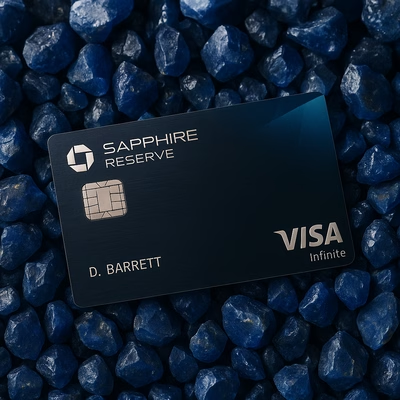
Chase Sapphire Reserve Ultimate Guide: The Premium Card’s $795 Transformation (August 2025)
Last updated: August 2025
When Chase announced they were increasing the Sapphire Reserve’s annual fee from $550 to a staggering $795 in June 2025, the credit card world collectively gasped. This wasn’t just a modest adjustment—it was a 45% increase that positioned the Sapphire Reserve as one of the most expensive personal credit cards on the market, surpassing even the legendary Amex Platinum Card.
But here’s where things get interesting: Chase didn’t just jack up the price and call it a day. They completely reimagined what a premium travel card could be, stuffing the Sapphire Reserve with over $2,700 in potential annual value through an almost comical array of statement credits, earning boosts, and luxury perks. It’s like they took the “throw everything at the wall and see what sticks” approach to premium card design.
The result? A card that’s either a brilliant value proposition for heavy spenders or an overengineered monument to fee creep, depending on your perspective (and spending habits). Let’s dive deep into whether this ultra-premium transformation makes sense for your wallet.
The Great Fee Increase of 2025: What Actually Changed
On June 23, 2025, Chase pulled the trigger on the most dramatic credit card makeover in recent memory. The annual fee jumped from $550 to $795—but that’s just the beginning of the changes.
Timeline Breakdown
- June 23, 2025: New applicants get immediate access to all new benefits at the $795 fee
- October 26, 2025: Existing cardholders gain access to new benefits
- Next renewal date: Existing cardholders pay the new $795 fee
Chase was surprisingly generous with the transition, giving existing cardholders months to evaluate the new benefits before the fee increase hits their wallets.
What $245 More Buys You
Chase’s value proposition centers on what they claim is over $2,700 in annual cardmember value. Here’s the breakdown:
New Statement Credits:
- $500 The Edit Credit: For luxury hotel bookings through Chase’s curated collection
- $300 DoorDash Benefits: Statement credits plus complimentary DashPass membership
- $300 Dining Credits: Access to exclusive restaurant reservations plus statement credits
- $300 Entertainment Credits: StubHub/viagogo credits plus Apple TV+ and Apple Music
- $120 Lyft Credits: Monthly statement credits for rideshare
- $120 Peloton Credits: Annual statement credits for fitness subscriptions
Enhanced Earning Structure:
- 8x points on Chase Travel purchases (up from 5x)
- 4x points on direct airline and hotel bookings (up from 3x)
- Points Boost: Up to 2 cents per point value on select redemptions
The catch? Many of these benefits are highly specific statement credits that only provide value if you were already planning to spend in these categories. It’s the “couponification” of premium cards taken to its logical extreme.
Earning Rates: The Good, The Bad, and The Strategic
The Sapphire Reserve’s earning structure got a complete overhaul in 2025, creating some interesting strategic opportunities while eliminating others.
New Earning Categories
| Category | Old Rate | New Rate | Change |
|---|---|---|---|
| Chase Travel | 5x | 8x | +60% |
| Direct Airlines/Hotels | 3x | 4x | +33% |
| Other Travel | 3x | 1x | -67% |
| Dining | 3x | 3x | No change |
| Everything Else | 1x | 1x | No change |
The Strategic Implications
The changes create a clear hierarchy: Chase wants you booking through their portal first (8x points), direct with airlines/hotels second (4x points), and punishes everything else with just 1x points.
This is a significant shift from the previous “3x on all travel” approach, which was beautifully simple and rewarded any travel spending equally. Now you need to think strategically about where and how you book travel.
Winners:
- Heavy Chase Travel users who don’t mind the limited selection
- Business travelers who book directly with airlines for elite benefits
- Anyone who can maximize the 8x Chase Travel category
Losers:
- Third-party booking site users (Expedia, Booking.com, etc.)
- Travelers who prefer booking through other travel portals
- Anyone who valued the simplicity of “3x on all travel”
Ultimate Rewards: Still the Gold Standard at 2.05 Cents
Despite all the changes, Chase Ultimate Rewards points remain one of the most valuable transferable currencies in the game. TPG’s August 2025 valuations peg them at 2.05 cents each, making them incredibly valuable for strategic redemptions.
Point Values Across Redemption Methods
- Transfer Partners: Up to 2.0+ cents per point (varies by partner and route)
- Points Boost: Up to 2.0 cents per point (select bookings only)
- Chase Travel Portal: 1.0-2.0 cents per point (depending on Points Boost)
- Cash Back: 1.0 cent per point (don’t do this)
The key insight: transferring to partners remains the sweet spot for maximum value, just like it always has been.
Transfer Partners: Where the Magic Happens
Chase’s 14 transfer partners (11 airlines, 3 hotels) offer some of the best redemption opportunities in the points world. All transfers are 1:1 and most are instantaneous.
Top-Tier Partners for Maximum Value
World of Hyatt: The Luxury Hotel Champion
Hyatt consistently delivers exceptional value because they still use a fixed award chart. Here’s why it’s special:
Sweet Spot Examples:
- Park Hyatt London River Thames: 25,000 points off-peak ($800+ rooms for $425 in point value)
- Andaz 5th Avenue NYC: 25,000 points off-peak (prime Manhattan location)
- Park Hyatt Marrakech: 25,000 points off-peak (luxury in Morocco)
- Alila Kothaifaru Maldives: 25,000 points off-peak (overwater villas in paradise)
With 200,000 Ultimate Rewards points, you could book eight nights at Category 7 properties—that’s potentially $3,200+ in luxury hotel stays.
Air Canada Aeroplan: Business Class Bargains
Aeroplan’s partner award chart offers some of the best premium cabin deals:
Business Class Sweet Spots:
- US to Europe: 60,000 points one-way (regularly $3,000+ in cash)
- US to South America: 60,000 points one-way
- US to Asia: 85,500 points one-way (under 11,000 miles)
- Stopovers: Add one for just 5,000 extra points
Real Example: Los Angeles to Paris in Air France business class for 60,000 points + minimal taxes, versus $4,500+ cash price. That’s 7.5 cents per point value.
Flying Blue (Air France/KLM): European Excellence
Economy Sweet Spots:
- US to Europe: Starting at 25,000 points one-way
- Peak Summer: Often 35,000-40,000 points when others are sold out
Business Class Value:
- US to Europe: 60,000 points one-way (often 45,000 with promotions)
- Excellent availability compared to other programs
Virgin Atlantic: UK Connections
Despite switching to dynamic pricing, Virgin still offers excellent value on off-peak dates:
- Saver awards to UK: Extremely competitive rates
- Partner bookings: Access to Delta, Air France, and KLM inventory
High-Value Redemption Examples
The Luxury Hotel Marathon
With 200,000 Ultimate Rewards points transferred to Hyatt:
- 8 nights at Park Hyatt properties worldwide
- Estimated cash value: $3,200+
- Point value: 1.6+ cents each
The Business Class European Getaway
Transfer 120,000 points to Air Canada Aeroplan:
- Round-trip business class to Europe
- Estimated cash value: $6,000+
- Point value: 5.0 cents each
The Hawaii Distance-Based Steal
Transfer 40,000 points to British Airways:
- Round-trip flights LAX to Honolulu in economy
- Avios required: 40,000 (20,000 each way under 3,000 miles)
- Cash equivalent: $600-800
- Point value: 1.5-2.0 cents each
The Chase Trifecta: Maximizing Your Earning Power
The Sapphire Reserve’s true power emerges when combined with Chase’s no-annual-fee cards in what’s known as the “Chase Trifecta.”
The Perfect Trifecta Setup
Chase Sapphire Reserve ($795 annual fee)
- Travel and dining spending
- Transfer partner access
- Premium benefits
Chase Freedom Unlimited (no annual fee)
- 5% on Chase Travel bookings
- 3% on dining and drugstores
- 1.5% on everything else
Chase Freedom Flex (no annual fee)
- 5% on rotating quarterly categories (up to $1,500 per quarter)
- 3% on dining and drugstores
- 1% on everything else
Q3 2025 Freedom Flex Categories
- Gas stations and EV charging
- Select live entertainment
- Instacart purchases
Strategic Spending Approach
With the trifecta, your optimal spending strategy becomes:
- Travel: Sapphire Reserve (4x direct, 8x Chase Travel) or Freedom Unlimited (5x Chase Travel)
- Dining: Any of the three cards (3x points)
- Quarterly categories: Freedom Flex (5x points)
- Everything else: Freedom Unlimited (1.5x points)
Pro Tip: The Freedom cards earn “cash back” that becomes Ultimate Rewards points when you have a Sapphire card, effectively turning them into 5x and 1.5x point-earning machines.
Annual Earning Potential Example
For a household spending $75,000 annually:
- $15,000 dining: 45,000 points (Freedom Flex/Unlimited at 3x)
- $12,000 travel: 48,000-96,000 points (depending on booking method)
- $6,000 quarterly categories: 30,000 points (Freedom Flex at 5x)
- $42,000 everything else: 63,000 points (Freedom Unlimited at 1.5x)
Total: ~186,000-234,000 points annually, worth $3,800-$4,800 at 2.05 cents per point.
Is the $795 Fee Worth It? The Brutal Math
Let’s cut through the marketing fluff and look at the real numbers.
Breaking Even Analysis
To justify the $795 annual fee purely through earning rates (ignoring benefits), you’d need to generate about $795 worth of additional points versus a no-fee card earning 1x everywhere.
With 3x dining and 4x travel vs. 1x everything:
- Need ~$265 monthly in combined dining and travel spending
- That’s $3,180 annually in these bonus categories
- Generates additional $64 in point value monthly ($795 annually)
Most premium card users easily hit this threshold, making the earning rates alone justify the base cost.
The Benefits Gambit
Chase claims over $2,700 in annual value through statement credits and perks. Here’s the reality check:
High-Probability Value (~$900-1,200):
- $300 travel credit (if you travel)
- $120 Lyft credits (if you use rideshare)
- Priority Pass lounge access (valuable for frequent travelers)
- Global Entry credit ($100 every 4-5 years)
Medium-Probability Value (~$400-800):
- $500 The Edit credit (if you book luxury hotels through Chase)
- $300 dining credits (if you dine at participating restaurants)
- Apple subscriptions ($250 value if you use them)
Low-Probability Value (~$420):
- $300 DoorDash credits (very targeted spending)
- $300 entertainment credits (specific vendors only)
- $120 Peloton credits (if you have a membership)
Reality: Most users will extract $1,200-1,800 in annual value, making the effective annual fee around $0-$400 for optimal users.
Who Should Get the Sapphire Reserve in 2025?
Ideal Candidates
The Luxury Travel Enthusiast
- Travels frequently (6+ trips per year)
- Values lounge access and travel protections
- Can utilize multiple statement credits
- Annual travel spend: $8,000+
The Chase Ecosystem Devotee
- Already has Freedom cards
- Wants to maximize Ultimate Rewards earning
- Comfortable with Chase Travel booking platform
- Total Chase ecosystem spending: $50,000+
The Premium Benefits Collector
- Uses multiple streaming services
- Dines at upscale restaurants regularly
- Takes rideshares frequently
- Can activate most statement credits
Who Should Skip It
The Casual Traveler
- Takes 1-2 trips per year
- Annual travel spend under $3,000
- Won’t use most statement credits
- Prefers simple, straightforward rewards
The Third-Party Booking Fan
- Prefers Expedia, Booking.com, etc.
- Values booking flexibility over earning rates
- Doesn’t want to change booking habits
- Won’t utilize Chase’s travel portal
The Fee-Sensitive User
- Any annual fee feels excessive
- Prefers cash back to points
- Won’t optimize statement credit usage
- Happy with simpler reward structures
Alternatives to Consider
If the $795 Sapphire Reserve feels too rich for your blood, consider these alternatives:
Chase Sapphire Preferred ($95 Annual Fee)
- 5x on Chase Travel, 3x dining and select streaming
- 2x other travel purchases
- Transfer partner access (same as Reserve)
- 1.5x points boost (vs. Reserve’s 2x)
- Much more reasonable fee structure
For detailed comparison, check out our Chase Sapphire Preferred vs Amex Green vs Citi Strata Premier analysis.
American Express Platinum Card ($695 Annual Fee)
- Different benefit structure focused on airline perks
- Broader lounge access network
- 5x on flights and prepaid hotels
- More established luxury brand partnerships
See our comprehensive Amex Platinum vs Chase Sapphire Reserve comparison for full details.
Citi Strata Elite ($595 Annual Fee)
- Lower annual fee with solid benefits
- Unique American Airlines transfer partnership
- 6x/3x dining, 12x/6x travel booked on Citi Travel
- 1.5x other purchases
- Four Admirals Club passes annually
The Verdict: A Premium Card for Premium Users
The 2025 Chase Sapphire Reserve represents everything right and wrong with premium credit cards today. On one hand, it offers genuinely valuable Ultimate Rewards points (2.05 cents each), excellent transfer partners, and enough statement credits to potentially justify the hefty annual fee. On the other hand, it’s become a complicated maze of specific spending requirements and targeted benefits that feel designed more for marketing brochures than real-world usage.
Bottom Line: If you’re a frequent traveler who can utilize 4-5 of the major statement credits and spend at least $50,000 annually across the Chase ecosystem, the Sapphire Reserve offers genuine value despite its eye-watering $795 fee. For everyone else, the Chase Sapphire Preferred offers 85% of the value at a fraction of the cost.
The Chase Trifecta strategy remains one of the most powerful approaches to maximizing credit card rewards in 2025—just make sure you’re not paying for premium benefits you’ll never use.
Want to explore more premium card comparisons? Check out our ultimate travel credit cards guide or dive into alternative trifecta strategies like the Wells Fargo Autograph combination.