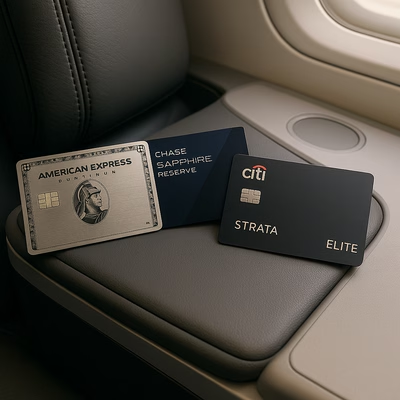
The Ultimate Premium Credit Card Showdown: Amex Platinum vs Chase Sapphire Reserve vs Citi Strata Elite (August 2025)
Last updated: August 2025
The premium travel credit card landscape has undergone seismic shifts in 2025, with each major issuer repositioning their flagship products to capture different segments of affluent travelers. The American Express Platinum Card maintains its position as the luxury travel standard, while Chase dramatically elevated the Sapphire Reserve to ultra-premium status, and Citi introduced the compelling new Strata Elite to challenge both competitors.
This comprehensive analysis reveals that each card serves distinct traveler profiles: the Amex Platinum excels for luxury seekers who value comprehensive lounge access and lifestyle credits, the Chase Sapphire Reserve now targets ultra-premium travelers willing to pay the highest fee for maximum earning potential, while the Citi Strata Elite emerges as an intriguing middle-ground option offering unique American Airlines transfer capabilities.
Annual Fees and Value Propositions: The New Premium Hierarchy
The annual fee structure across these three premium cards reflects their distinct positioning strategies in the competitive travel rewards market. Chase made the most dramatic move in 2025, increasing the Sapphire Reserve’s annual fee from $550 to $795 effective June 23, 2025, making it the most expensive card in this comparison. This $245 increase positions the Sapphire Reserve as the ultimate premium offering, eclipsing both The Platinum Card from American Express at $695 annually and the newly launched Citi Strata Elite at $595.
Chase justifies this substantial fee increase by claiming to offer over $2,700 in annual cardmember value through enhanced earning rates, expanded statement credits, and premium travel benefits. The value proposition centers on significantly increased earning potential, with 8x points on all Chase Travel purchases and 4x points on direct airline and hotel bookings. Additionally, Chase introduced new statement credits including a $500 annual The Edit credit for luxury hotel bookings and Points Boost redemption opportunities that can provide up to 2x value on select travel redemptions.
The American Express Platinum Card maintains its $695 annual fee while continuing to offer what Amex describes as over $1,500 in annual value through a comprehensive suite of benefits. The value calculation includes $240 in digital entertainment credits covering subscriptions to Disney+, ESPN+, Hulu, The New York Times, Peacock, and The Wall Street Journal, along with $200 in annual Uber Cash distributed as $15 monthly plus a $20 December bonus.
The Citi Strata Elite represents the newest entrant in this premium space, launching in July 2025 with a $595 annual fee and positioning itself as offering nearly $1,500 in annual value. Citi’s value proposition focuses on unique benefits not available from competitors, including four complimentary American Airlines Admirals Club passes annually and exclusive 1:1 point transfers to American Airlines AAdvantage.
Earning Rates: Different Philosophies for Different Travelers
The earning rate structures of these premium cards reflect fundamentally different philosophies about how cardholders prefer to book and pay for travel.
Chase Sapphire Reserve: Portal-First Strategy
Chase completely overhauled the Sapphire Reserve’s earning structure in 2025, creating a system that heavily rewards bookings through Chase Travel while maintaining competitive rates for direct bookings:
- 8x points on all travel booked through Chase Travel
- 4x points on flights booked directly with airlines and hotels booked directly
- 3x points on dining worldwide
- 1x point on all other purchases
This new structure simplifies the earning landscape while maintaining high earning potential for portal bookings. However, Chase significantly reduced earning rates on other travel categories, dropping from 3x points per dollar to just 1x point per dollar on cruises, vacation rentals, travel agencies, and other non-airline/hotel travel purchases.
American Express Platinum: Focused Premium Strategy
The Platinum Card maintains a more focused earning structure, concentrating on specific high-value categories:
- 5x points on flights booked directly with airlines or through Amex Travel
- 5x points on prepaid hotel bookings through the Amex Travel portal
- 1x point on all other purchases
This structure rewards both direct airline bookings and portal hotel bookings, though it doesn’t provide bonus earning on direct hotel bookings. The Platinum Card also includes 1x point per dollar on all other purchases, making it less versatile for everyday spending compared to its competitors.
Citi Strata Elite: Aggressive Portal Incentives
The Citi Strata Elite employs the most portal-centric earning structure of the three cards:
- 12x points on hotels, rental cars, and attractions booked through Citi Travel
- 6x points on flights purchased through Citi Travel
- 6x points on dining during “Citi Nights” (Friday 6 PM to Sunday 6 AM ET)
- 3x points on dining at all other times
- 1.5x points on all other purchases
This aggressive earning rate on portal bookings significantly exceeds both competitors, though it requires commitment to Citi’s travel booking platform. The unique “Citi Nights” feature provides enhanced earning on weekend dining, while the 1.5x base earning rate provides the strongest everyday earning rate among the three cards.
Transfer Partners: The Key to Maximum Value
The transfer partner ecosystems of these three cards represent perhaps their most significant differentiating factors, as these partnerships determine the ultimate redemption value and flexibility of earned points.
American Express Membership Rewards: The Gold Standard
American Express Membership Rewards boasts the most extensive transfer partner network, with relationships spanning multiple airline alliances and hotel chains. The program includes transfer partners across all three major airline alliances:
Oneworld partners: British Airways, Cathay Pacific, and Qantas
SkyTeam partners: Air France-KLM, Delta Air Lines, and Aeromexico
Star Alliance partners: Air Canada, ANA All Nippon Airways, and Singapore Airlines
Key American Express transfer partners include premium carriers like Singapore Airlines, which offers exceptional first and business class products, and British Airways, whose Avios program excels for short-haul flights within Europe and domestic US travel. Emirates provides access to one of the world’s most luxurious first class experiences, while Delta Air Lines offers extensive domestic coverage and international partnerships.
Hotel transfer partners include both Hilton at a 2:1 ratio (1,000 Membership Rewards points transfer to 2,000 Hilton Honors points) and Marriott at a 1:1 ratio, though hotel transfers generally provide lower value than airline transfers.
Chase Ultimate Rewards: Quality Over Quantity
Chase Ultimate Rewards maintains a more focused but highly valuable transfer partner portfolio with 14 total partners comprising 11 airlines and 3 hotels:
Star Alliance partners: Air Canada Aeroplan, Singapore Airlines KrisFlyer, and United Airlines MileagePlus Oneworld representation: British Airways Club and Iberia Plus SkyTeam access: Air France-KLM Flying Blue Independent carriers: Emirates, JetBlue TrueBlue, Southwest Airlines Rapid Rewards, and Virgin Atlantic Flying Club
The Chase hotel transfer partner selection focuses on quality over quantity, featuring three of the most valuable hotel loyalty programs: World of Hyatt, IHG One Rewards, and Marriott Bonvoy. World of Hyatt stands out as particularly valuable due to its award chart structure and the relative difficulty of earning Hyatt points through other means.
Citi ThankYou Points: The American Airlines Advantage
The Citi ThankYou transfer partner network has evolved significantly with the introduction of American Airlines AAdvantage as a transfer partner, available exclusively to holders of the Citi Strata Elite, Strata Premier, and legacy Prestige cards. This partnership makes Citi the only major US bank offering direct point transfers to American Airlines, providing unique access to one of the world’s largest airline loyalty programs.
Citi’s broader transfer partner network includes 15 airline programs with varying transfer ratios. Premium partners transferring at 1:1 ratios include Qatar Airways, Singapore Airlines, Air France-KLM, JetBlue, Virgin Atlantic, and several others. Some partners operate at reduced 1:0.7 ratios, including Avianca, Asia Miles (Cathay Pacific), and Etihad Airways.
Lounge Access: Where the Premium Experience Begins
Airport lounge access represents one of the most tangible and frequently used benefits of premium travel cards, with each card offering distinct approaches to providing travelers with comfortable airport experiences.
American Express Platinum: The Centurion Standard
The American Express Platinum Card delivers the most comprehensive lounge access program, anchored by exclusive access to American Express Centurion Lounges, widely regarded as the gold standard for credit card lounges. The Centurion Lounge network includes flagship locations in major US airports, with the Atlanta location spanning 26,000 square feet and featuring premium dining, full-service bars, shower suites, and outdoor terraces.
Beyond Centurion Lounges, Platinum Card holders receive:
- Delta Sky Club access when flying Delta (limited to 10 annual visits)
- Priority Pass Select membership providing access to over 1,400 lounges across 140 countries
- Entry to select Lufthansa lounges, Escape Lounges, Plaza Premium lounges, and other Global Lounge Collection partners
Chase Sapphire Reserve: Growing Premium Network
The Chase Sapphire Reserve provides lounge access through multiple channels:
- Priority Pass Select membership offering access to over 1,300 lounges worldwide for cardholders and up to two accompanying guests
- Access to the growing Chase Sapphire Lounge by The Club network, currently operating in Boston, New York (LGA and JFK), Philadelphia, Phoenix, San Diego, and Hong Kong, with Las Vegas, Los Angeles, and Dallas locations opening soon
- Access to select Air Canada Maple Leaf Lounges and Air Canada Cafes across the US, Canada, and Europe when departing on Star Alliance member airline flights
Citi Strata Elite: The American Airlines Advantage
The Citi Strata Elite takes a unique approach to lounge access by combining Priority Pass Select membership with four complimentary American Airlines Admirals Club passes annually. This combination provides both broad international coverage through Priority Pass and specific high-quality access to American’s premium lounges, which serve nearly 50 locations worldwide.
The Admirals Club passes are particularly valuable given the typical $59-79 day pass rates for these lounges, and they provide access to American’s flagship lounges in major hubs like Dallas-Fort Worth, Miami, and Los Angeles.
Statement Credits: Lifestyle Benefits Beyond Travel
The statement credit portfolios of these premium cards reflect different philosophies about how affluent consumers prefer to receive value beyond earning and redemption opportunities.
American Express Platinum: Comprehensive Lifestyle Coverage
The Platinum Card offers the most diverse array of statement credits, totaling over $1,500 in potential annual value:
- $240 Digital Entertainment Credit for subscriptions to Disney+, ESPN+, Hulu, The New York Times, Peacock, and The Wall Street Journal
- $200 annual Uber Credit ($15 monthly plus $20 December bonus)
- $200 airline incidental fee credits for seat upgrades, baggage fees, and in-flight purchases
- $100 Saks Fifth Avenue credit (delivered as two $50 credits semi-annually)
- $200 Fine Hotels + Resorts credit for premium hotel bookings through Amex Travel
Chase Sapphire Reserve: Luxury Travel Focus
Chase redesigned the Sapphire Reserve’s benefit structure in 2025 to provide over $2,700 in claimed annual value:
- $500 annual The Edit credit for bookings at Chase Travel’s curated collection of over 1,100 hand-picked luxury hotels and resorts
- Points Boost redemption accelerator that can provide up to 2x value on thousands of hotels and flights booked through Chase Travel
- Enhanced travel insurance and protection benefits
Citi Strata Elite: Strategic Value Propositions
The Citi Strata Elite provides nearly $1,500 in annual value through a combination of statement credits and unique benefits:
- $300 annual hotel credit for hotel bookings
- $200 annual “Splurge Credit” for lifestyle purchases
- $200 annual Blacklane credit (delivered as two $100 credits) for premium ground transportation services
- Banking relationship credits that can dramatically reduce the effective annual fee for qualifying Citigold clients
Card Trifectas: Strategic Combinations for Maximum Value
Credit card trifectas represent sophisticated strategies for maximizing rewards earning across different spending categories by combining complementary cards from the same issuer ecosystem.
The American Express Trifecta: Luxury Optimization
The core Amex Trifecta consists of:
- The Platinum Card as the premium travel and lifestyle benefits anchor
- The American Express Gold Card for enhanced everyday spending (4x dining, 4x US supermarkets)
- The Blue Business Plus Credit Card for general spending coverage (2x on all purchases up to $50,000 annually)
Total annual fees: $945 ($695 Platinum + $325 Gold + $0 Blue Business Plus)
The Chase Trifecta: Enhanced Earning Potential
The traditional Chase Trifecta combines:
- Chase Sapphire Reserve as the premium travel card (8x Chase Travel, 4x direct bookings, 3x dining)
- Chase Freedom Unlimited for general spending (1.5x on all purchases)
- Chase Freedom Flex for rotating bonus categories (5x on quarterly categories up to $1,500 per quarter)
Total annual fees: $795 ($795 Sapphire Reserve + $0 Freedom Unlimited + $0 Freedom Flex)
The Citi Trifecta: The New Contender
The Citi Trifecta combines:
- Citi Strata Elite as the premium travel card (12x Citi Travel, 6x dining, exclusive AA transfers)
- Citi Strata Premier for everyday enhanced earning (3x on broader categories)
- Citi Double Cash Card for simple, high-rate cash back (2% on all purchases)
Total annual fees: $690 ($595 Strata Elite + $95 Strata Premier + $0 Double Cash)
Point Valuations and Redemption Examples
Understanding point valuations across different rewards currencies is essential for making informed decisions about credit card selection and redemption strategies.
American Express Membership Rewards: 2.2 Cents Per Point
The Points Guy values American Express Membership Rewards at 2.2 cents per point as of August 2025, reflecting the program’s extensive transfer partner network and redemption flexibility.
High-Value Redemption Examples:
- Singapore Airlines Suites Class from Singapore to Hong Kong: 45,000 KrisFlyer miles (transferred from Amex) for a $8,000+ flight = 18+ cents per point
- Virgin Atlantic Upper Class from New York to London: 120,000 Flying Club miles for a $6,000+ flight = 5+ cents per point
- Delta First Class from Los Angeles to New York: 60,000-80,000 SkyMiles for a $2,000+ flight = 2.5-3.3 cents per point
Chase Ultimate Rewards: 2.05 Cents Per Point
Chase Ultimate Rewards points carry a 2.05 cent valuation according to TPG’s August 2025 assessments, positioning them slightly below Membership Rewards but well above most other transferable currencies.
High-Value Redemption Examples:
- World of Hyatt Park Hyatt Maldives: 35,000 Hyatt points for a $1,000+ night = 3+ cents per point
- Singapore Airlines Business Class from San Francisco to Singapore: 185,000 KrisFlyer miles for an $8,000+ flight = 4+ cents per point
- Virgin Atlantic Business Class from major US cities to London: 120,000 Virgin miles for a $5,000+ flight = 4+ cents per point
Citi ThankYou Points: 1.8 Cents Per Point
Citi ThankYou Points receive a 1.8 cent valuation from Upgraded Points, reflecting the program’s smaller transfer partner network but acknowledging the unique value proposition of American Airlines transfers.
High-Value Redemption Examples:
- American Airlines Business Class from New York to London: 120,000 AAdvantage miles for a $4,000+ flight = 3.3+ cents per point
- Qatar Airways QSuites from major US cities to Doha: 140,000 Avios for a $6,000+ flight = 4.3+ cents per point
- Singapore Airlines Suites from Singapore to Hong Kong: 45,000 KrisFlyer miles for an $8,000+ flight = 18+ cents per point
Strategic Recommendations: Which Card Is Right for You?
The selection among these three premium cards depends heavily on individual spending patterns, travel preferences, banking relationships, and lifestyle priorities.
Choose the American Express Platinum If You:
- Value comprehensive lounge access and Centurion Lounge experiences
- Utilize multiple digital entertainment subscriptions (Disney+, Hulu, etc.)
- Frequently use Uber services in urban environments
- Appreciate Fine Hotels + Resorts benefits for luxury accommodations
- Want maximum transfer partner flexibility for international premium cabin redemptions
- Can maximize lifestyle credits to offset the annual fee
Best for: High-income professionals who travel frequently for business, wealthy retirees with significant leisure travel, and urban dwellers who can maximize the Uber credits and entertainment benefits.
Choose the Chase Sapphire Reserve If You:
- Book frequently through Chase Travel and can utilize the $500 The Edit credit
- Prioritize earning rate maximization over annual fee considerations
- Are a Chase ecosystem loyalist who wants to maximize Ultimate Rewards earning
- Can utilize Points Boost for enhanced redemption value
- Value the growing Chase Sapphire Lounge network
- Are willing to pay the highest annual fee for maximum benefits
Best for: Ultra-high-net-worth individuals who prioritize earning rate maximization, frequent luxury travelers who can utilize The Edit credit effectively, and Chase ecosystem loyalists.
Choose the Citi Strata Elite If You:
- Are an American Airlines loyalist who values the exclusive AAdvantage transfer partnership
- Frequently dine out on weekends and can maximize the Citi Nights bonus
- Prefer booking through online travel agencies rather than directly with carriers
- Are an existing Citigold client who can leverage banking relationship credits
- Want premium benefits without the highest annual fees
- Value unique benefits like Admirals Club passes over comprehensive lounge networks
Best for: American Airlines loyalists, moderate-to-high spenders who want premium benefits without the highest annual fees, and existing Citi clients who can leverage relationship benefits.
The Trifecta Decision: Maximizing Your Overall Strategy
For consumers seeking to maximize their overall rewards strategy, card combinations and trifectas provide opportunities to optimize earning across all spending categories while maintaining access to premium benefits and transfer partners.
The Amex Trifecta Advantage
High restaurant and supermarket spenders may prefer the Amex Trifecta due to the Gold Card’s 4x dining earning rate and 4x US supermarket rate. The combination provides exceptional earning potential for everyday spending while maintaining access to premium travel benefits and the industry’s most extensive transfer partner network.
The Chase Trifecta Advantage
Frequent travelers might benefit from the Chase Trifecta’s enhanced travel earning rates, particularly the new 8x rate on Chase Travel bookings and 4x rate on direct airline and hotel bookings. The Points Boost feature can provide exceptional redemption value when available, effectively doubling the return on investment for points earned across the entire trifecta system.
The Citi Trifecta Advantage
The Citi Trifecta appeals to consumers seeking simplicity and American Airlines access. The exclusive AAdvantage transfer partnership provides redemption opportunities not available through other transferable points programs, particularly valuable for travelers who frequently fly American Airlines or prefer AAdvantage award availability and routing options.
Conclusion: The Evolving Premium Landscape
The premium travel credit card landscape in August 2025 reflects the evolving needs and preferences of affluent consumers who demand both exceptional earning potential and comprehensive lifestyle benefits from their financial products. Each of these three flagship cards serves distinct market segments while competing intensely for the highest-spending customers.
The American Express Platinum Card maintains its position as the luxury standard through comprehensive lounge access and lifestyle benefits, justifying its $695 annual fee through over $1,500 in potential annual value and the industry’s most extensive transfer partner network.
Chase’s dramatic repositioning of the Sapphire Reserve to a $795 annual fee represents a bold attempt to capture the ultra-premium segment through maximum earning potential and exclusive benefits like The Edit credit and Points Boost redemptions. While the higher fee creates barriers for some consumers, the enhanced value proposition can justify the cost for frequent luxury travelers who can fully utilize the card’s benefits.
Citi’s introduction of the Strata Elite at $595 provides a compelling alternative that combines competitive benefits with unique features like exclusive American Airlines transfers and Admirals Club access. The card’s positioning between its competitors in terms of both fees and benefits creates opportunities to capture consumers who find the Platinum Card’s benefits insufficient and the Sapphire Reserve’s fees excessive.
The evolution of these premium cards reflects broader trends in the credit card industry, including the increasing importance of lifestyle benefits beyond traditional travel perks, the complexity of redemption structures that reward engaged consumers, and the premium consumers place on exclusive access and personalized experiences.
Looking ahead, the competitive dynamics in the premium travel card space will likely intensify as issuers seek to justify increasingly high annual fees through enhanced benefits and earning opportunities. Consumers benefit from this competition through improved value propositions, though the complexity of these products requires careful analysis to determine optimal choices for individual circumstances.
The cards analyzed here represent the current pinnacle of the premium travel card market, each offering distinct value propositions that serve different consumer segments while pushing the boundaries of what premium credit cards can provide. Success in this market segment requires not just competitive features but also superior execution of benefits, customer service, and the overall cardholder experience.
For more information on maximizing your credit card rewards strategy, check out our comprehensive guide to travel credit cards in 2025 and our detailed analysis of the Citi Trifecta strategy.
This article is current as of August 2025. Credit card benefits, fees, and terms are subject to change. Always verify current information directly with the card issuer before applying.